
Change Management
Leadership
From Frustration to Engagement: Start Designing for Outcomes
Most communication fails before the first sentence is written. Not because the message is wrong, but because we often start in the wrong place. The better starting point is outcome. What do we need the audience to understand, decide, support or do? In this article, Martin Adams explores a simple shift from creating content to designing communication around the result we need. A practical read for leaders who need to turn complex work into clear decisions, action and engagement.

Published on KJM
•
2 Sep 2026
From Frustration to Engagement: Start Designing for Outcomes
Most communication fails before the first sentence is written.
Not because the work is wrong or the recommendation is weak. It fails because we start in the wrong place.
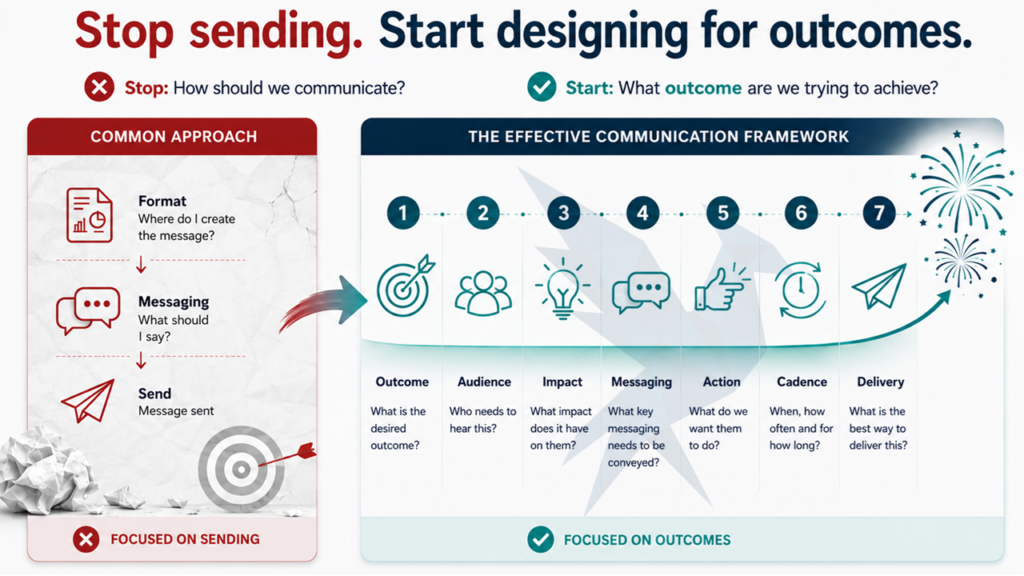
In most organisations, communication still begins with format and messaging. We decide how it will look, what we want to say, and then we send it. It is efficient, but it is centred on the sender. It reflects how we think about the work rather than what the audience needs in that moment.
I see this consistently in technology and transformation environments. Strong teams do solid work, yet struggle to land it. The issue is rarely the quality of thinking. It is how that thinking is translated.
The visual with this post captures the shift well. On the left is the default pattern. On the right is what experienced operators tend to do, whether they realise it or not.
Start with intent
Before anything is written or formatted, be clear on the outcome they are trying to achieve. That choice shapes everything that follows. Are we trying to:
-
inform
-
build understanding
-
influence a position
-
secure a decision
-
drive action
-
sustain a behaviour
Different outcomes require different communication. Without that clarity, communication drifts and the audience is left to interpret what matters.
Design the rest around it
Once the outcome is set, the rest becomes more deliberate. The audience is defined properly, not broadly. The impact is considered from their perspective rather than ours. The message is tightened to what actually needs to be retained. The required action is explicit. The cadence is set with intent. And delivery is treated as a design decision in its own right. Sometimes the outcome calls for a considered visual deck. Sometimes a short Slack message lands it perfectly. The format, medium and method are chosen to suit the outcome, not habit or convenience.
This is not theory. It is a simple discipline that moves communication from activity to outcome.
Where it usually breaks down
Where teams struggle is predictable. The message does not land, so the instinct is to add more. More detail, more context, more slides. Partly to inform, but often to prove the work is thorough and the recommendation is sound.
The effect is usually the opposite. The signal gets buried. The audience disengages, not because they are unwilling, but because the communication has not been shaped around the decision or action required.
Lead with what the audience needs
There is a difference between what we know and what the audience needs. Experienced leaders separate the two. They lead with the outcome and support it with enough context to move things forward. The depth is held back for when it is genuinely required, typically when questions like these surface:
-
Have we considered alternatives
-
What happens if we delay
-
What risk are we accepting
-
Why is this the right recommendation
That is where detail earns its place. Not in the opening message.
Why this matters
Communication is often described as a soft skill. At leadership level, that label undersells it. It is how work gets understood, supported and executed. It is the difference between strong thinking creating value and strong thinking stalling.
Most teams do not have a communication problem in the way they think they do. They have a lack of clarity on the outcome they are trying to achieve.
Final thought
Get the outcome right, and the rest follows. The framework in the image isn’t complex. It simply makes the intent visible.
Tagged Change Management, Leadership