How would you like to explore this case study?
The same real-world application, viewed through two different perspectives. Choose the one most relevant to you.
You can explore both. Switch to the alternative view at any point using the selector within the case study.
From vibe coding to connected business software.
AI did not just help us build screens faster. It let us rethink where lightweight custom software can sit inside an existing enterprise ecosystem, connecting marketing, customer data, workflow, calendars and follow-up without creating another isolated application stack.
Follow one enquiry from thought leadership to today’s work.
The animation tells the business story and the technology story together. Each hand-off shows what the person does, what information moves, and why the integration has been designed that way.
Watch an enquiry become today’s work.
Follow the customer action on screen, then watch the hand-off explain what moves between systems and why.

Confidence to Navigate
Workforce, Payroll and
Technology Change
Whether you're solving payroll challenges, implementing new technology or improving business processes, KJM provides the expertise and support to help you move forward with certainty.
Home
Relationships, follow-ups and opportunities requiring attention.
Create Teams meeting
Calendar
Teams • Sarah Mitchell
The principles behind the build.
This is a simplified mock-up of KJM's own relationship and marketing application, built with AI and used operationally by our team. It shows a fraction of the functionality, but every design decision on screen is deliberate. The interesting part is not that AI wrote the screens faster. It is where the application sits: inside the Microsoft 365 environment, so identity, access and foundational platform security are inherited rather than recreated.
The design begins with how someone actually runs their day, not with the technology. The CRM opens on today's priority actions, not a database to browse.
Attribution, contact, enquiry and meeting context move with the work across the website, CRM, Calendar and Teams. Nobody re-keys, and nothing is lost in the hand-offs.
We did not build a security model. We inherited one. The public enquiry holds no customer data. Everything sensitive lives under Microsoft 365 identity, access and logging, with least-privilege applied on top. Leverage the platform's controls rather than reinventing them.
SharePoint Lists are the lightweight data layer today, with a defined path to Azure SQL when scale, performance or data complexity justify it. Platform capabilities where they fit, licences and infrastructure only when the requirement earns them.
AI makes a prototype look finished in hours. The performance limits only surface under load, and security gaps may only be found if someone knows where to look and test. Fast agile rebuilds do not help if the same fault is rebuilt each time. That judgement, not the code, is the real work.
We built this one for ourselves.
The CRM shown in the animation is KJM's own relationship and marketing application. We use it operationally, so we have to live with the security, usability, supportability and future-change decisions we make.
There’s more to explore. Choose your lens.
We’ll take you through the same opportunity from the perspective that matters most to you. Choose Business for value, risk and agility, or Technology for architecture, controls and support.
Your curated case study starts with your perspective.
Choose the lens above that best matches the decisions you make. We’ll take you through the same opportunity with the emphasis placed on what matters most to you.
You already own more of an application platform than you think.
Microsoft 365 and Google Workspace are much more than email, documents and meetings. Both provide the building blocks for secure applications, workflow, business data, collaboration and integration.
Different technology underneath. Similar business opportunity.
Build applications around your business
Create tailored operational tools for workflows, approvals, registers, case management, CRM and other gaps without automatically buying another SaaS product.
Automate work end-to-end
Route work, trigger actions, manage approvals and remove manual hand-offs using capabilities already available inside the ecosystem.
Use the security environment you already trust
Do not create unnecessary risk by trying to secure another external system. Build inside the authenticated environment your staff already use, with established identity, access and governance.
Turn everyday tools into a connected process
Bring documents, email, calendars, meetings, collaboration and business data into the workflow instead of leaving them as disconnected places people have to manage.
Create structured business data
Capture the information needed to run and measure a process while keeping it connected to the documents, people and actions that give it meaning.
Use integrations you already have
Connect services and move information between them using integration capability already available within the platform before introducing another middleware or application layer.
AI expands the opportunity. It also scales the threat.
AI helps legitimate teams move faster. It also gives bad actors the ability to search for, test and exploit weaknesses at a scale that was previously difficult or expensive to achieve.
AI can help attackers hunt for vulnerabilities at machine scale.
As vulnerability discovery and exploitation accelerate, the window between a weakness being found and being used can shrink dramatically. For many organisations, replicating the specialist security teams, threat intelligence, testing capability and remediation capacity needed to defend that surface is neither practical nor affordable.
Build behind the strongest walls you already have.
Microsoft and Google invest in dedicated threat intelligence, red teams, security engineering and rapid remediation at global scale. By inheriting their identity, access and platform controls rather than recreating them, the application has a better chance of evolving as the threat does.
What happens after it is built?
These are the questions that should be answered before an AI-assisted application goes live. Fast construction is useful. Clear ownership, support and continuity are what make it sustainable.
They do not need to build it.
Internal IT retains control of architecture, security, access, data and technology standards. Specialist application capability can be brought in under those guardrails, just as it is for other technologies.
Design for change from day one.
Versioned source code, documented architecture, known dependencies and repeatable deployment mean enhancements become controlled application changes, not another rebuild.
Support is part of the product.
Define the business owner, internal IT responsibilities and application support partner before go-live, with clear escalation and release responsibilities.
The organisation owns the application.
Source code, data, documentation, deployment instructions and release history remain with the client. In the AI era, taking over an unfamiliar codebase is easier than ever: a capable developer can use AI to understand the application quickly rather than reverse-engineering it from scratch. KJM goes further by providing the source code, update and deployment instructions, and a master development prompt that captures the design thesis, architectural decisions and security guardrails so future AI-assisted changes start from the same principles.
Only if speed overrides governance.
AI accelerates construction. It does not replace security review, performance testing, engineering judgement, governance or support planning. The production bar stays the same.
Build, buy or wait.
AI changes the economics, but it does not make build the default answer. The right decision depends on where tailoring creates value and where maturity, regulation or scale matter more.
Buy
Use mature SaaS where specialist capability, regulation, scale or product depth justify it.
AI-assisted build
Use existing enterprise platforms where fit, integration and ongoing economics create more value than another broad product.
Wait
Do not build when ownership, process, data or support responsibility is still unresolved.
Tailor where fit creates advantage. Buy where maturity matters more.
Build where fit creates value.
- Workflow and approvals
- Internal operational tools
- Registers and case management
- Lightweight CRM and relationship management
- Document and knowledge applications
- Project and work management
- Integrations and gaps around core systems
Buy where proven maturity matters more.
- Payroll calculation and award interpretation
- Financial ledgers and core accounting engines
- ERP core transaction processing
- Payments
- Safety-critical or clinical decision systems
- Highly regulated transactional platforms
- Complex, high-volume transaction engines
Build agility for an uncertain AI future.
AI is changing markets, customer expectations and operating models faster than traditional technology roadmaps can anticipate. You do not need to predict every change. You need systems that can adapt quickly when it comes.
You cannot remove the uncertainty. You can design your business to respond to it.
Build an environment that lets you change a workflow, connect a new service, add a proven AI capability or scale only the part that needs it, without forcing a major re-platform every time the landscape shifts.
Different tools. The same architectural discipline.
Microsoft 365 and Google Workspace can support the same business opportunity, but the technical building blocks differ. Architecture follows the ecosystem already in place.
Document & knowledge application
Relationship & marketing application
The journey is simple. The architecture is deliberate.
AI-generated code does not receive a lower production bar. Identity, API boundaries, data ownership, deployment and support still need explicit design.
What sits underneath the animated cable
The light pulse represents a record or controlled action moving through governed platform services.
Every security layer you own becomes another thing Tech must defend.
AI is compressing vulnerability discovery and exploitation. A custom security control, public endpoint or exposed data layer does not just add code. It adds an incident-response and patching obligation.
Identity, MFA, session management, core access controls and much of the underlying platform hardening stay with Microsoft or Google, where dedicated security teams, threat intelligence and AI-assisted testing operate continuously. The less bespoke security surface we create, the less custom patching burden the Technology team inherits.
In an AI-accelerated threat environment, reducing unnecessary attack surface is part of the architecture, not an afterthought.Support after the build.
A production application should not depend on the person who first built it. Choose a partner that designs support, governance and continuity into the delivery from day one.
What you shouldn't have to ask for.
A client should not need to know every production question to ask. The disciplines that make software secure, supportable, valuable and sustainable should already be part of the delivery standard.
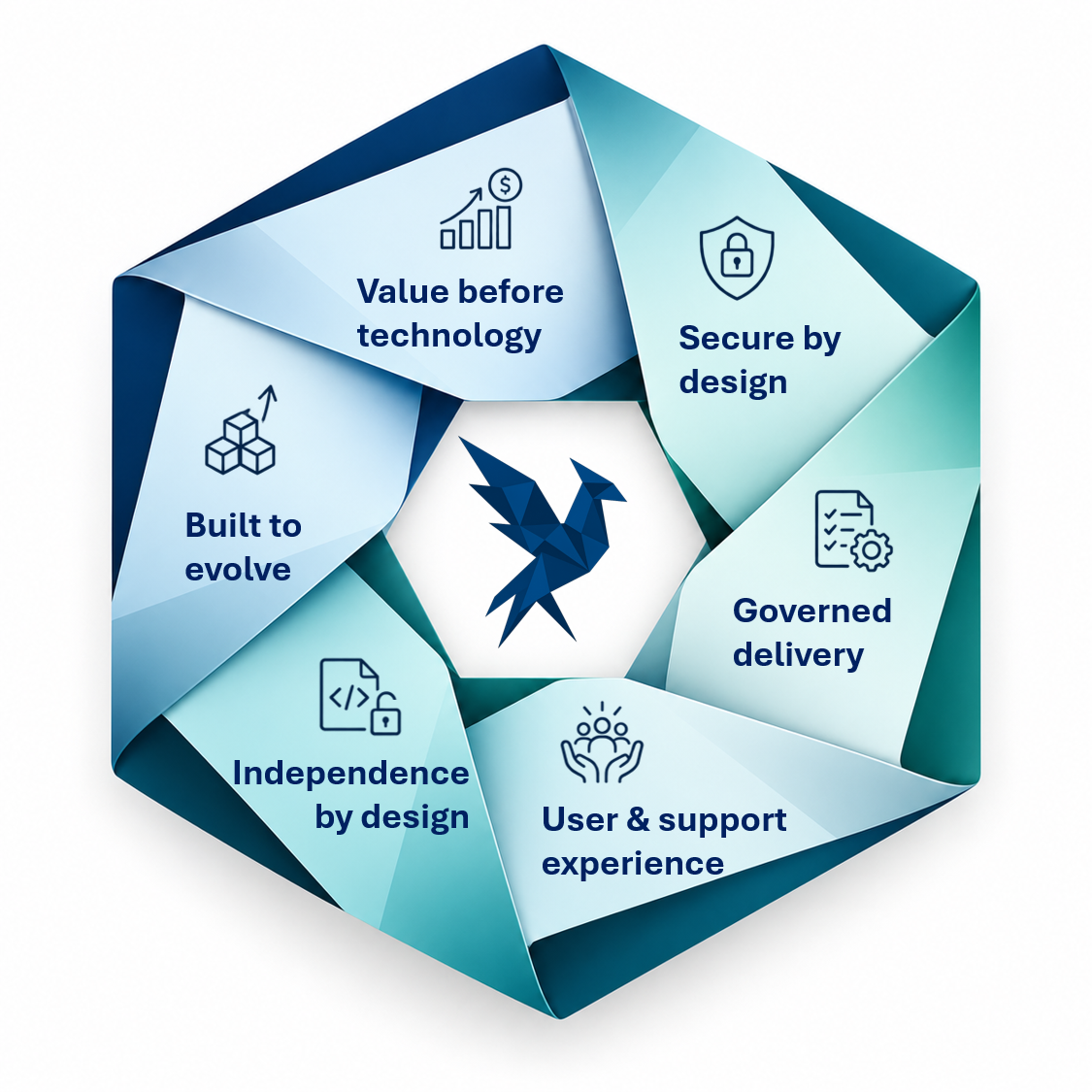
We solve the business problem first, then choose the technology that creates the best value. Sometimes the right answer is to build, sometimes to buy, and sometimes to wait.
Architecture, identity, data and access are considered from the outset rather than treated as a production hardening exercise at the end.
Requirements, testing, performance, change and production readiness remain part of the software-development process, even when AI compresses construction.
We design for the people who use the application and the people who have to support it after go-live.
Source code, documentation, deployment guidance and master development prompts stay with you so the application is not dependent on its original builder.
Architecture, data and integrations are designed so the application can adapt as requirements, scale and AI capability change.
We bring these disciplines to every project.
We do not wait for you to request secure architecture, governed delivery, value-aligned development, a strong user and support experience, client ownership or a path to future change. They are designed in from day one.
Could AI change your build-versus-buy equation?
We can help identify where existing platforms, AI-assisted development or SaaS make the strongest commercial sense.
AI changed the cost of construction. It did not repeal good technology management.
That creates a new middle ground between spreadsheets, generic SaaS and traditional custom development. The opportunity is real, but only when architecture, governance, engineering judgement, user experience and support are treated as part of the product.